Fish have evolved a variety of different physical features and behaviours in order to survive.
Successful predators capture their prey using a variety of techniques and behaviors.
While the features of some marine animals may make them appear intimidating, it’s not all about the size or teeth when it comes to hunting prey.
Fish hunt for prey actively or passively
When fish search for food, they can do this actively by pursuing their prey or passively by waiting for their prey to come to them.
The most efficient predators will choose their food and their method of hunting to get the maximum amount of nutrition without using a lot of energy.
For example, a great white shark may use a lot of energy roaming the oceans in search of food but it will typically feed on large and high calorific food such as seals and turtles. This gives them more energy than feeding on smaller animals.
In comparison a Wobbegong shark may use little energy by lying on the sea floor camouflaged with into its surroundings waiting for its prey to swim overhead. When the prey passes by, the shark opens its large mouths and rapidly inhale their prey.
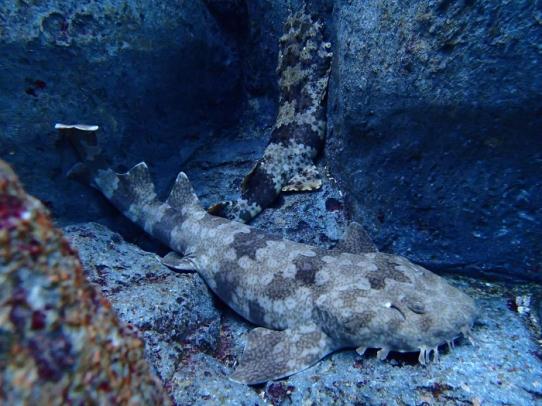
Wobbegong sharks are camouflaged to their environment which helps them hunt for prey.
Activating all senses in the hunt
Fish will rely on an array of different senses when trying to hunt their prey. For example Bluefin tunas spend the majority of their lives in open water and rely heavily on vision. Built like torpedoes, their eyes are flush to their body these fish have the sharpest vision of any bony fish.
Sharks have an additional ‘sixth sense’ which allows them to detect electrical pulses–a great tool when searching for food. Even if their prey is hiding in the coral reef or under sand, electrical pulses from the prey’s muscle contractions can be sensed by the sharks.
As most sharks feed at night, vision is used less and their sense of smell is well developed. Blacktip and Grey Reef sharks have been shown to be able to detect the equivalent of one drop of fish extract in an Olympic sized swimming pool.
Fish that ambush their prey
Some fish can be less agile and more passive when it comes to searching for food. They aim to save energy through camouflage whereby they can lie and wait for their unsuspecting prey.
Some animals already have a camouflaged colouration which helps them to blend with the environment, making them difficult to be seen. Stonefish lie buried in their surroundings with their eyes and mouth facing upwards.
A stonefish will strike at prey just in between their mouth and their dorsal fin. The stonefish can actually raise its dorsal fin and chase the fish back to the strike zone.
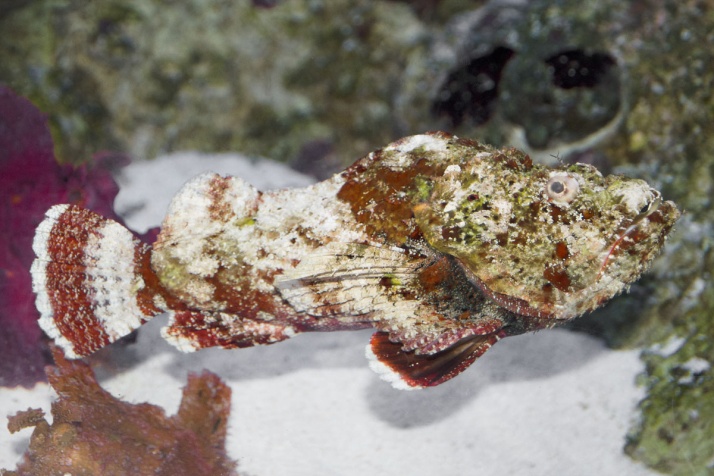
False stonefish are ambush predators using camouflage to blend in with the environment
Some ambush predators may also casually swim amongst their prey; the prey becomes less aware of their presence and therefore grows careless. This technique is known as ‘habituating’ and is used by many marine animals to ambush their prey.
Fish that attack in groups
Many mammals have been shown to hunt in packs such as wolves, lions and killer whales. While this isn’t the most popular way for fish to feed, some fish have adopted this behaviour.
A group of fish together may be more successful when searching for food. A common tactic when hunting in a large group is to encircle shoaling fishes- this is called herding.
In the Indian Ocean, Blacktip Reef sharks have been observed herding schools of mullet against the shore for easier feeding.
